

You Don't Need a Perfect Routine to Finish a Novel: an Interview with Author C.C. Hammond
Real Talk! On letting go of perfection and self doubt so you can write.


Many writers are trying to figure out how to keep writing alongside everything else in their lives.
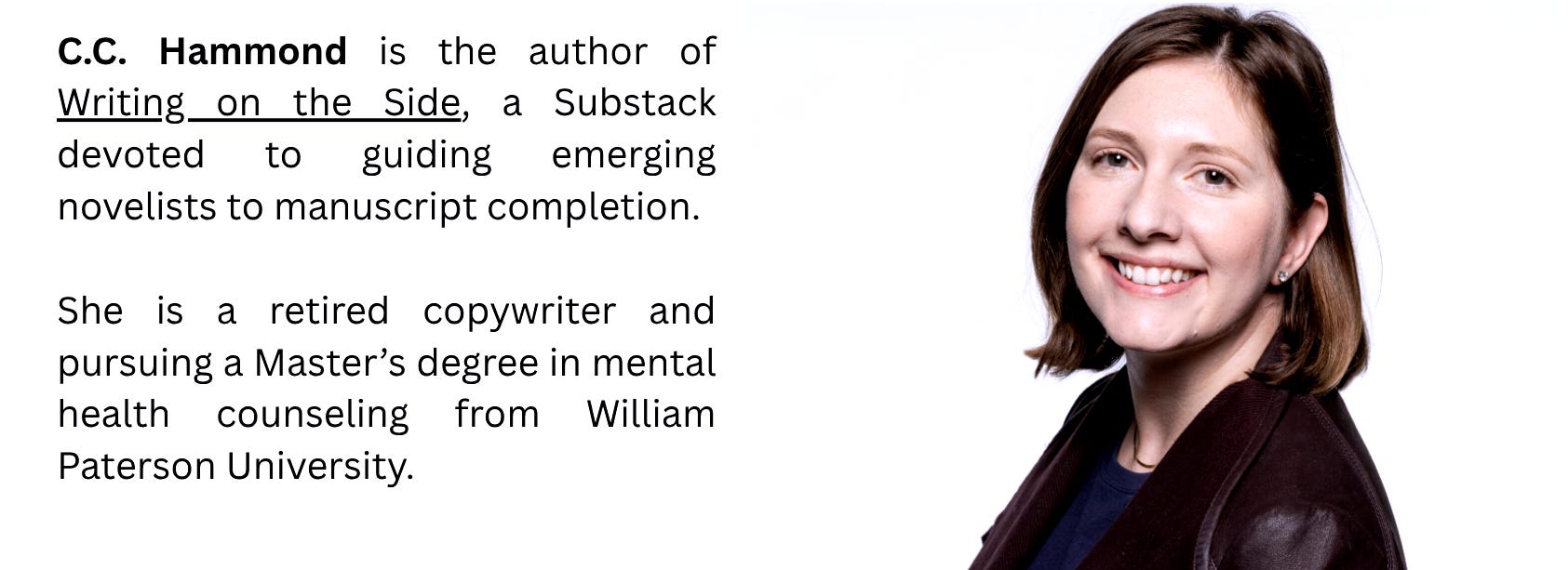
C.C. Hammond writes Writing on the Side on Substack, where she focuses on what it actually takes to build a writing practice that fits into a full life. Perfect routines and ideal conditions are a dream for most writers. Most of us need a writing practice that holds up over time and through all our other responsibilities.
In our conversation, C.C. shares how she moved from self-doubt to completing multiple full-length manuscripts, what she means by the “Writer’s Mindset,” and how writers can keep going even when writing isn’t the priority every day.
Real talk! Let’s go!
Join C.C. Hammond’s newsletter at Writing on the Side!
Welcome to Author Gold, C.C. Hammond!
What was happening in your own writing life when you started Writing on the Side? And who does it serve?
I launched my Substack on Jan 1st this year and like many who start out, I didn’t have a clear strategy. I knew I wanted to write about where mental health and writing collide. There are strategies I’ve learned, and I can debunk myths about writers as tortured depressives or overachieving geniuses.
Then I came across Substack growth content that asked, what problem do you know how to solve? I kept returning to how I overcame self doubt as a younger writer. For a long time I thought I could never write anything long; that I didn’t have the ability to scope something out as big as a novel, but now I’ve written a full-length (over 50k word) manuscript four times. And been proud of two of them. So, I realized what I know how to do and who I can speak to about it: that writer waiting in the wings, struggling to make her novel come true.
“I kept returning to how I had overcome self doubt as a younger writer. I can speak to that writer waiting in the wings, struggling to make her novel come true.” - C.C. Hammond
You talk about the “Writer’s Mindset” as something distinct. What exactly is it?
The “Writer’s Mindset” is one of growth and one that prioritizes progress, truth-telling, improvement, and creation over an editor’s or a publisher’s mindset.
The Mindset is about telling yourself, “I want to write. I write because I’m a writer with a story to tell.”
“I believe in separating the Mindset from the tactics.” - C.C. Hammond
One thing I learned from participating in National Novel Writing Month in my twenties and just making all kinds of mistakes as a young writer, is that what keeps you going is not recognition or an idea of greatness, it’s the love of doing and growing and getting better. And when you eventually get to a finished product, you make people feel things with your writing.
To be clear, there are plenty of days I do not belly up to my keyboard with a sunny disposition, excited about my word count. I actually refer to writing as a “curse” in some of my posts. But it’s a curse I joyfully accept, if that makes sense!
What does the “Writer’s Mindset” look like in daily life for someone writing alongside their other responsibilities?
I believe in separating the Mindset from the tactics. In many ways, the tactics are the easy part. Instead of saying, “I have to write every day at 5am so I can become a great novelist or become the next [hot name here],” it’s about “I know in my heart that I’m a writer. I believe I am meant to write. So I write when I can, as much as I can, often. And I surround myself and connect with other likeminded people.”
What beliefs about writing did you have to learn (or unlearn) in order to make this Mindset sustainable?
Writing is one of many of my hats that I wear, and it cannot - and does not - take priority every single day. The truth about a productive writing life, for me, is similar to being good at anything: it craves balance and a humble yet open attitude toward growth.
I think about writing and my work every day. But I’m also a parent, a wife, a grad student, an adult child to my parents, etc. So some days writing takes a backseat, and that’s okay. That’s not failure or lack of rigor, that’s life!
Practically, that means I see writing as a practice more than an identity. I try to write more days than not, and acknowledge that not every day is going to yield glittering output. It’s okay to make mediocre things sometimes!
“I see writing as a practice more than an identity.” - C.C. Hammond
What does your daily writing practice actually look like right now?
I’m not working on a first draft at the moment, but I’m planning to start my next novel in May. Right now, I am probably sitting down for true writing/editing sessions around 3x per week (excluding days I’m writing grad school papers and Blackboard posts!). Because my grad student schedule is reasonably flexible, I’m usually writing in the late morning. However, most of my writing life, I was an 8pm writer, usually writing for 45 minutes to-an hour at a stretch. Also, I like to write on my couch. I’m very rarely a desk writer. My husband judges me for my poor ergonomics. :)
When other responsibilities compete for attention, how do you decide what gets your best creative energy and what gets set aside?
I don’t have a hard and fast formula. A lot of it is by gut. I have a 5 year old son, so if he’s sick or has a surprise school cancellation, writing is usually off the table until he’s asleep, and that’s an easy decision to make, because he is my priority right now.
With the heaviness of the past couple of years in the United States, I also take days off when a news cycle is hitting particularly hard. Last year I got laid off from my job shortly after the inauguration and did not write for close to a month. I came back to my book when I was ready.
I fully believe in prioritizing rest when you need it. I’ve written about how I did not read or write for almost the entirety of 2020; I see that now as a trauma response. And I don’t judge those times; they just are what they are. They don’t make me less of a writer. It’s just… being a person.
“[Rest days] don’t make me less of a writer. It’s just… being a person.” - C.C. Hammond
Once in a while, I take the rest days to think about how my character would deal with whatever I’m dealing with. Play out some scenarios in my head. Those days are helpful, I think.
What are the biggest challenges writers on the side are facing right now?
Traditional publishing is not hospitable right now to new writers and that’s obviously an understatement. That doesn’t mean I think anyone should discount it entirely (I am not), but it is discouraging when considering the massive amount of effort required for completing a manuscript and querying it, and the fact that the publishing industry seems to only want to onboard people who can market themselves.
I think it’s also pushing would-be authors to forsake their story truth for what’s trendy or publishable, leading to burnout or manuscript abandonment in the long term.
It’s also really regrettable the amount of pressure and the power dynamics at play right now in the white collar workspace, so I think for those of us writing on the side with laptop jobs, it’s a little harder than it used to be. Carving out time is harder now than it was just 5 years ago.
It’s going to be interesting to see where this all takes us!
In your experience, what do writers on the side worry about too much?
Questioning things like, Is this the “right” book for me to be writing right now? Is this publishable/marketable? Is my title/niche good enough? It’s not that these aren’t valid questions, but they only enhance the paralysis that is antithetical to the manuscript drafting phase.
It is also completely valid to write a novel for practice. I could write an entire post on this!
What other challenges do writers underestimate?
Going it alone is extremely hard and most people don’t realize that. It’s natural to want to keep your book a secret until it’s ready for eyeballs, but I very much discourage this. Writing can become lonely! But it does not have to be.
At the minimum, tell one person you’re writing a novel. Your partner, your best friend, your therapist. One person you can confide in and trust not to bug you about a timeline while also encouraging you not to abandon it (a very fine line to walk, but needed).
This is also why a virtual writers group is in the works for Writing on the Side, but I honestly cannot say enough about how vital it is to find people in real life, offline, who you can meet up with, talk shop, and share your works in progress.
How can writers tell when something is a genuine constraint in their life, as opposed to an expectation about how writing should be like?
There’s finding the time to write, and then there’s the belief that it’s worthwhile. If you are working three jobs as a single parent of six, you might not have time to write. I’ll buy that. But the vast majority of us are not in that boat, and can find time to write, regularly.
The belief is the hard part, and what I would start with. If you believe it’s worthwhile and can put your effort into the doing while shelving the outcome, you will find the time.
There was a time when you could not write a sentence. Like physically. We all start somewhere. Commit to the growth. If you commit to growth, you more or less become unstoppable. I believe that.
“If you commit to growth, you more or less become unstoppable. I believe that.” - C.C. Hammond
With a debut forthcoming and another novel underway, what do you expect to change about your writing life in 2026?
One big change is that I’m going to upgrade to a novel writing software! I have been writing in Google Docs and it’s time to level up! I think this will be a big positive change.
This whole proselytizing about writing is still very new for me! Before, it was very much like giving pep talks to my two writing besties. Now, I’m doing it to an audience of over 90 people. And I hope that number keeps growing.
So, I think I’m going to learn a lot about what resonates about my philosophy and tactics.
What advice has mattered most to you, and what advice do you think writers would be better off ignoring?
I don’t like the advice, “Write for yourself.” I see what the phrase is getting at, but it’s a little flat. The stakes should involve other people, but not “the Man” of the publishing world, if you get my drift.
I prefer the phrase, “Write the book you want to see in the world.” It speaks to your cultivated taste as a reader, and our taste and our gut instincts are really what makes us who we are as writers. The rest is just time and work. If you enjoy the story you’re putting down, if you believe it and the words and the people feel real to you, I think you’re likely onto something.
What is one last piece of advice you’d give those writing on the side?
Be gentle with yourselves. The world is a harsh and taxing place, especially for writers. Most of us are stretched thin, so the fact that you want to put more on your plate says positive things about your ambition, your capacity for ideas and imagination.
Remember that you are more than your drafts, you are more than what you get on a page in a day. If you can be gentle and kind to yourself as a writer, you’re more likely to keep showing up to make your work the best it can be.
Join C.C. Hammond at Writing on the Side!
Like what you’ve read here? Join me, Jen, at Author Gold and get the confidence and clarity to publish and market your books, while staying true to your voice, values and rights.
What resonates with you? If you’ve ever struggled with finding time, balancing responsibilities, or suffered self-doubt as a writer, would you share your story with us?
 | A guest post by
|
Love it 🩵🩵🩵!