
How Developmental Editors See What Writers Miss: An Interview with Marissa Frosch
An inside look at hidden story problems and how a developmental editor strengthens the manuscript without changing the author's voice.


You’ve spent months writing your manuscript. It’s been hard work but you are proud of it and you know your characters inside and out. You know why they make the choices they do, and you've been creating their story for so long that every scene is familiar.
But how do you know if it’s working for a reader?
What if the pacing drags in the middle? What if readers say they “just couldn’t connect with the characters,” even though they feel real to you? What if the ending doesn’t deliver the emotional payoff you intended?
These issues aren’t obvious to you, so close to your own manuscript. They’re also exactly the kinds of problems a developmental editor is trained to identify.
I sat down with developmental editor, Marissa Frosch, and founder of Raven’s Quill Publishing, to talk about what goes into developmental editing.
We talked about what developmental editors actually do, when writers should bring one into the process, the story problems she sees most often, and how thoughtful editing can strengthen a manuscript without changing the author's voice.
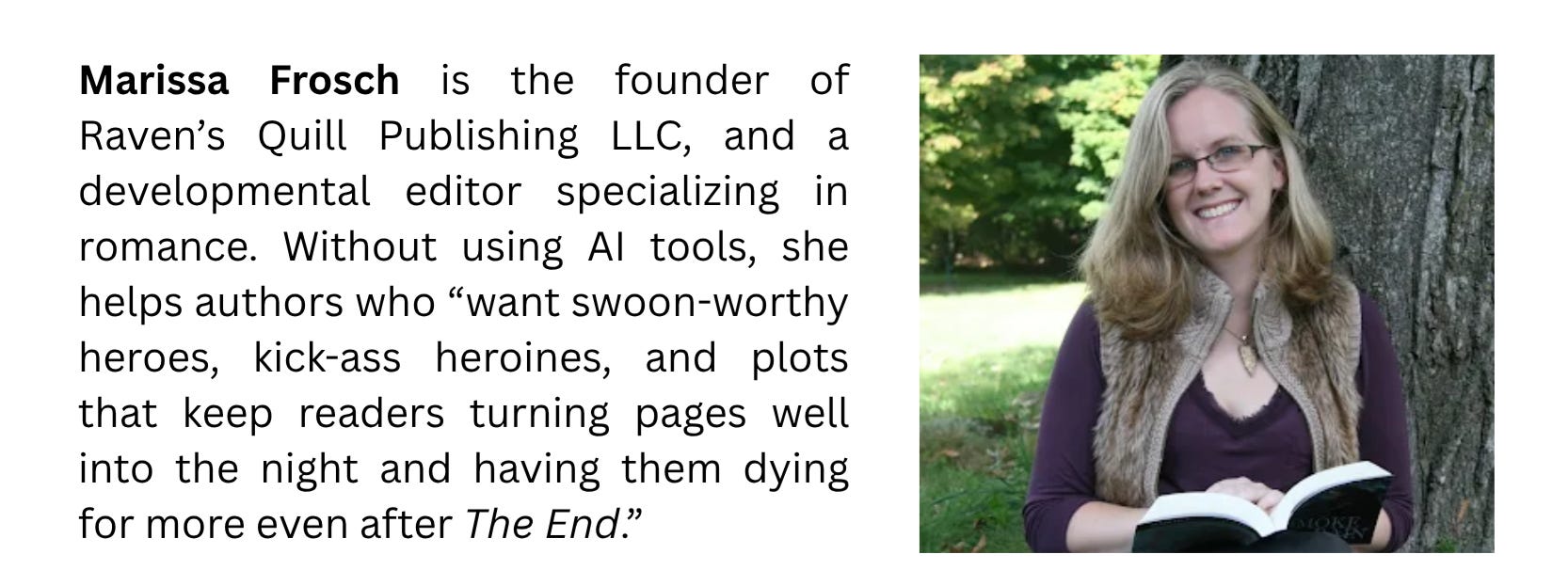
Connect with Marissa directly or subscribe to her newsletter at Raven’s Quill
New to Author Gold? I interview publishing professionals, dig into the research behind successful publishing, and share practical guidance so authors can make confident publishing decisions. I'd love to have you join us.
Welcome to Author Gold, Marissa! Here we go…
What does a developmental editor do?
Developmental editors focus on craft and structure to improve the reader experience and keep them coming back to you for more.
My focus is first, “does this story work and will the reader be satisfied?” Then I help the author draft the best version of their story so that readers will not only enjoy this book, but keep returning to that author for more stories.
When is the ideal time to bring in a developmental editor?
I work with authors at different stages depending on their needs, wants, and budget.
Some authors are looking for someone to help them plan their draft so it’s as close to structurally sound as possible after the first run through.
Some want me to help them after the first draft is complete.
While others have published a few books but haven’t gotten the response they expected or are looking for. When this is the case, it’s good to look at the product (book) itself first to make sure it’s the best it can be. After that, authors should look at covers and descriptions.
What does the developmental editing process actually look like?
The first step in my process is to make sure we’re a good fit for each other. Over a zoom call, I ask about your story and let you tell me where you think it could benefit from my expertise or where you think its strengths lie. Ask me questions and we can even spitball ideas about your story so you can get an idea of my style and I can sort out the vision you have for this particular piece.
Then I send a proposal. If the author agrees to that, then we work together.
If they need help drafting, we work weekly to build a blueprint so they know their story works before they even put one word on the page.
If they already have a draft, they send it to me, and I spend a month reading and analyzing it before sending over a document outlining any issues I’ve found with potential solutions. I also break the work to be done into steps so the author can take it one piece at time and avoid overwhelm. At that point, they can hire me to work through the draft with them if they wish.
Is your process different with authors who already have several books out?
For those authors, I use my expertise in marketing and editing. I look at their back list before our zoom call, including reviews and samples and tell them how I would proceed if I were them. If they choose to work with me, we will either go through their back list, or we start with something new so they can learn as they go and go through past works as they see fit once they have the tools to do so. These authors can walk through the drafting process with me or have me go through an existing draft depending on their time constraints and budgets.
How do you tell the difference between a manuscript that has a few scene-level issues, and one that has a deeper structural problem?
When the structure is nearly sound, they may be missing a key scene or reader expectations, but overall, we can start to focus on bigger and better things.
One that needs major work will likely have multiple scenes that don’t move the story or character development forward, and might not even have the basics of story.
It’s hard to write a book, and even if your draft is a mess, you should be proud of it. However, the one that’s a mess will need multiple drafts before it’s ready for publication. First, the author needs to focus on making the story work and cutting unnecessary scenes. Then you can go through for reader expectations and then focus on leveling up your craft.
What common story issues do you encounter when reading manuscripts?
I see it all. From unsatisfying endings, to poorly thought-out characters (especially villains), saggy middles, and bobbing boats.
Unsatisfying endings will ruin the reader’s experience, though sometimes they will try the author again in the hopes they can get it right, it just depends on how good your story or idea was before the ending. This is where knowing and understanding the basics of your genre’s story structure is crucial.
Saggy middles can cause readers to not finish your book faster than a poorly crafted protagonist. Middles are a common issue for writers because they’re twice as long as the endings and beginnings. It’s easy to get lost in trying to get the words in and forget each one still needs to count.
Bobbing boat is another common issue for new writers. The complication is riding the waves of your story like a boat, but the issue never really gets better or worse, it keeps showing up, like an annoying younger sibling to plague your reading experience. The same problem rising and then falling in the story makes it boring. Make sure each complication is unique and drives the story forward. An example from an indie author I read, was the reason the couple couldn’t be together, even though I, as the reader (pre editing certification) I had figured it out the first time it came up, the author kept having the female and male main characters think about this one issue over and over. It was a shifter romance, they had other things to worry about and the author could have created so many obstacles, but she didn’t.
Poorly thought-out characters. When you write a character, especially your protagonist and antagonists, you need to make sure they are not morally black and white. No person is perfectly good or evil and adding those redeeming qualities to your villain or bad habits/traits to your hero, makes all the difference in how they’re perceived. Remember, the villain should always believe he’s the hero. Personally, in my work, I have to write out scenes that explain why they are the way they are (both hero and villain) before I start writing, these aren’t scenes I intend to keep usually, but they help me get a better understanding of my characters and build their voices in my head. Each author needs to figure out what works for them when character building.
Many writers worry about losing their own voice. How do you help authors strengthen their story while preserving their unique style and voice?
Voice is less of a factor with developmental edits as it’s structure based. However, when I help new authors just starting out, sometimes there needs to be a focus on discovering their voice.
I got a crash course in this recently. I took a job as an English Teacher at my son’s school and we’ve been working on short stories to create an anthology for the students. While some had really strong natural voices, others needed help find their voice. And as we go through line edits, this is where we need to focus on making that voice stronger while keeping the story clear for the reader. It was a fun experience and I’ve found it was easier than I anticipated to keep my own voice out of their stories as I edit them.
If you know you wrote something how you want the character to sound, you can reject the editor’s suggestions without a second thought. But it’s still the editor’s job to point it out and let you make the final decision.
Can you share an example of how developmental editing transformed a manuscript?
I can tell you what learning this process did for my writing. When I started out, I was publishing serials partly because I like the episodic style, but also because when I tried to write longer fiction, I’d get lost in it and end up wasting six months writing 80k words that went absolutely nowhere. A whole book’s worth of nothing.
After my certification, I worked with a fellow editor. He walked me through creating a blueprint in six months, I wrote 74k words (that worked!) in 17 days, and then (after a brief pause) I edited it in three months. The speed with which I was able to get through the process was great, but the quality of my first novel was much better than it would have been without the help of my new found knowledge of story but also his. Working with an editor makes a huge difference in process and quality.
“Working with an editor makes a huge difference in process and quality.” - Marissa Frosch, Developmental Editor
What’s one myth about developmental editing that you wish more writers understood?
A lot of authors seem to think beta and alpha readers do the same thing as developmental editors, and while they may focus on the same things, whether or not you find one who is actually trained and has studied reader satisfaction in your genre, is difficult. It can also be more difficult to get them to follow through. This is why I prefer to hire an editor, and why I became one.
Final Thoughts
Have you ever worked with a developmental editor? Or, if you haven’t, what’s your biggest hesitation?
How do you know when your manuscript is ready for developmental editing?
Developmental editing is an investment.
In “Is Your Manuscript Ready for a Developmental Edit?” you'll learn how to tell whether it’s ready for professional feedback, or whether another round of revision could save you time, money, and frustration before you make the investment.
Cheering for you,
Jen | Author Gold
Learn more and subscribe to Marissa’s Newsletter, Raven’s Quill.

 | A guest post by
|
Great interview. As I have been editing my manuscript and being held accountable by my book partner-- he actually hired an editor, thinking she was going to do what he thought and she did something entirely different. We both are learning there are many different types of editors. I had no idea.